
Chapter One: Turning Financial Data into Investment Intelligence
How financial data becomes an investment thesis—and how AMAAS is evolving into an evidence-based research platform.
Most investment software produces numbers. AMAAS is evolving into something different: an evidence-based research platform that assembles quantitative models, macroeconomic context, financial quality, and event intelligence into a coherent investment thesis.
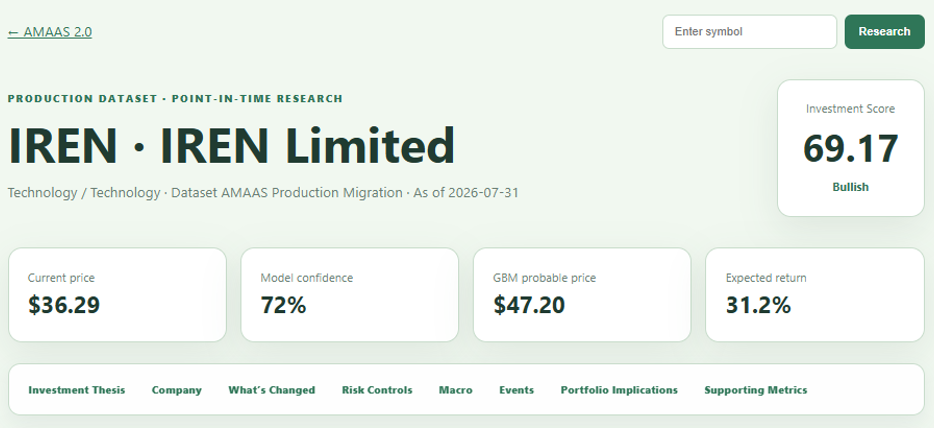
The IREN research report illustrates this transition. Rather than beginning with disconnected tables, the report begins with an investment thesis, summarizes supporting evidence and principal risks, explains why the current economic environment matters specifically for the company, and concludes with portfolio implications and supporting metrics.
From Metrics to Reasoning
Traditional platforms answer, “What is the score?” AMAAS increasingly asks, “Why does the score exist?” Each analytical engine contributes evidence that is synthesized into a narrative instead of leaving the investor to interpret disconnected statistics.
The narrative layer is not intended to hide the quantitative models behind polished language. It organizes the evidence so a financial professional can see the conclusion, trace the supporting factors, identify contradictory signals, and decide whether the thesis deserves further research.
The goal is not to replace professional judgment. It is to give professional judgment a better evidence base.
Persistent Company Context
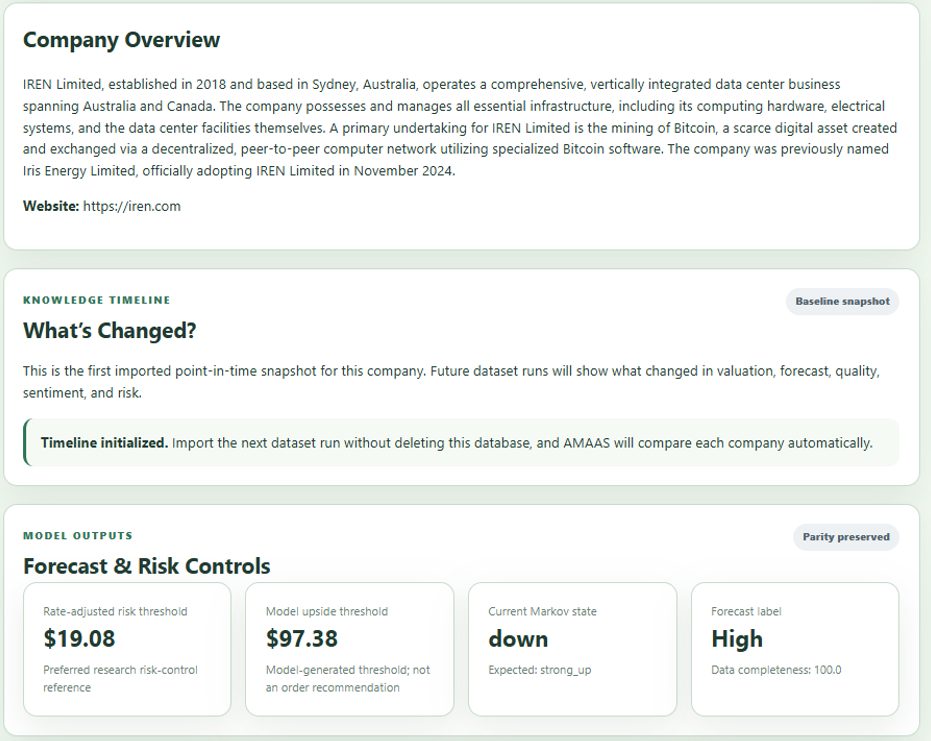
AMAAS 2.0 changes the way a company is represented over time. A research report is no longer a disposable snapshot. The knowledge timeline preserves point-in-time observations so later analyses can show how valuation, forecast, quality, sentiment, macro context, and risk changed from one dataset run to the next.
Economic Risk Assessment
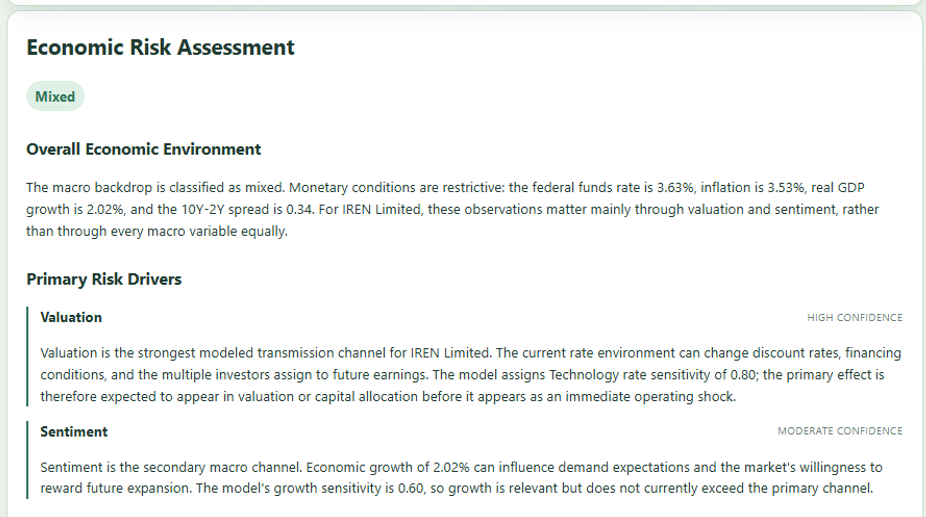
Macroeconomic information is most useful when it explains a transmission path rather than merely adding more indicators to a dashboard. AMAAS evaluates which economic variables are most likely to affect the company and how those effects may appear through valuation, sentiment, financing conditions, demand expectations, or operating risk.
For IREN, the current macro backdrop is classified as mixed. Valuation is identified as the strongest modeled transmission channel, while sentiment is secondary. Other macro variables remain observable, but they are not automatically given equal importance simply because the data are available.
Event Intelligence and the Discipline to Withhold
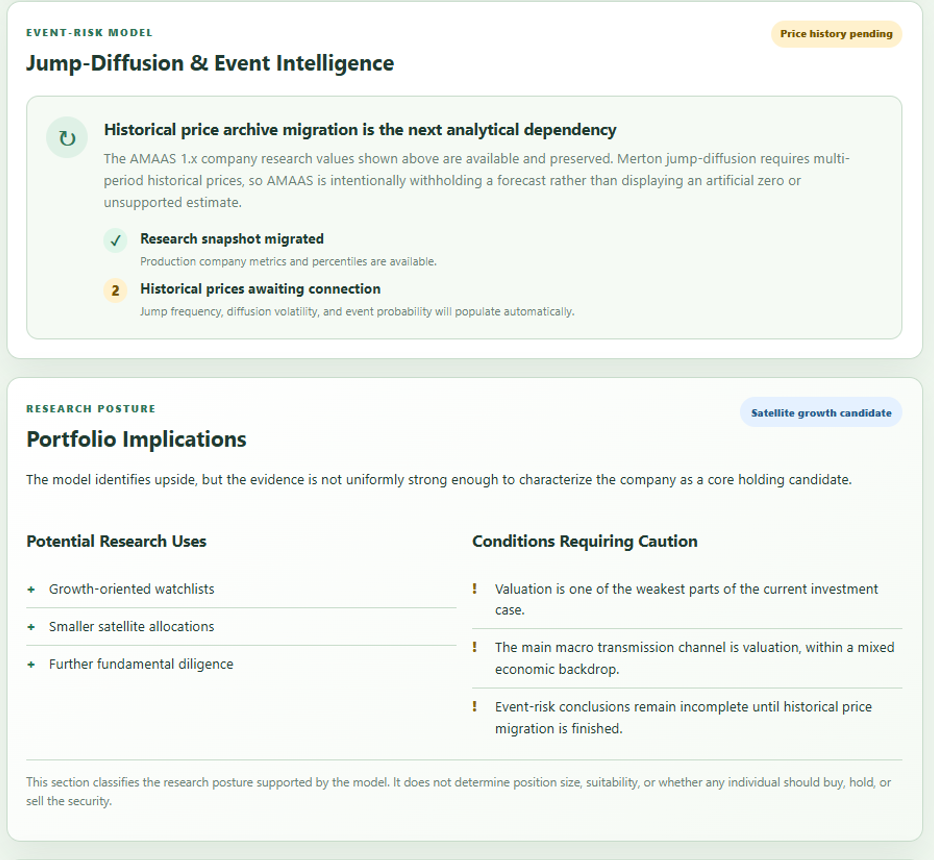
A powerful analytical platform should be willing to say when the evidence is incomplete. During the initial AMAAS 2.0 migration, the historical price evidence required by jump-diffusion and event-intelligence models had not yet been fully connected. The system therefore withheld an event-risk forecast instead of displaying an artificial zero or unsupported estimate.
That behavior became a design principle: missing evidence should remain missing until the system can support the conclusion.
Portfolio Implications Without Replacing the Investor
The portfolio section is deliberately framed as research posture. AMAAS can identify a company as a growth-oriented candidate, highlight conditions requiring caution, and suggest where deeper diligence may be warranted. It does not determine suitability, position size, or whether an individual should buy, hold, or sell a security.
This matters particularly for financial advisors and other professionals. AMAAS is designed to strengthen the research process by organizing evidence, exposing uncertainty, and reducing the time required to move from raw data to an informed decision—not to replace the professional who owns that decision.
The Evidence Remains Visible
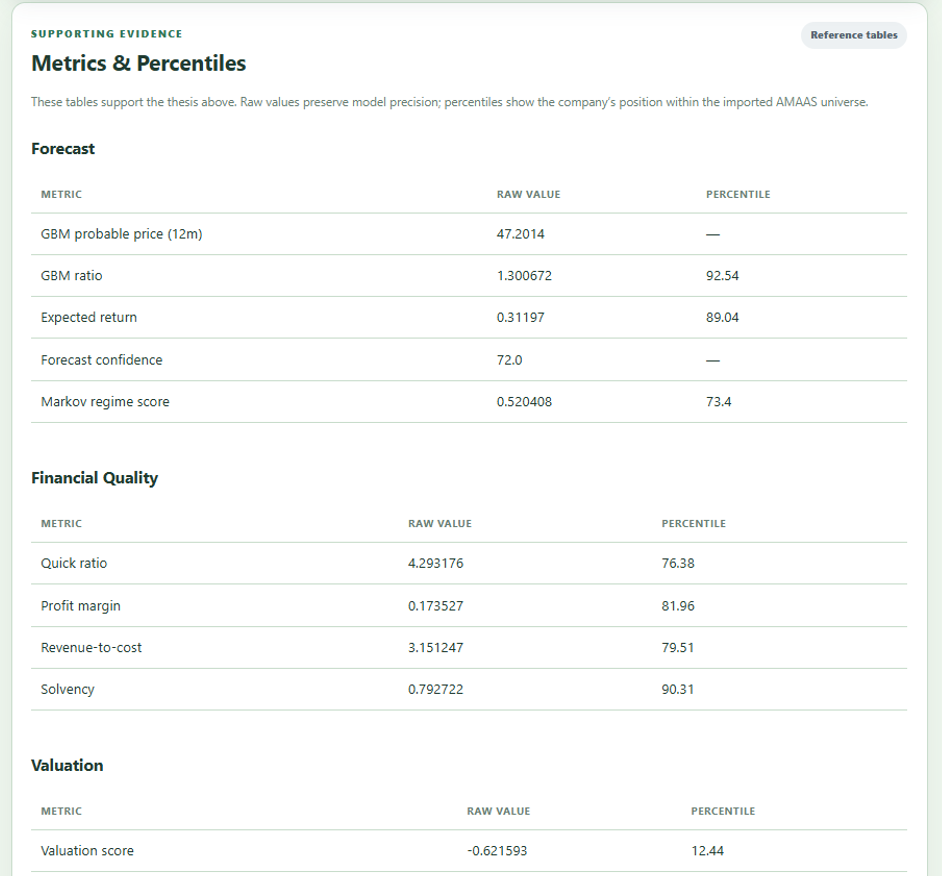
The narrative conclusion is supported by reference tables containing the underlying metrics and percentile ranks. Raw values preserve model precision; percentile values show the company’s relative position within the research universe. Forecast factors, financial quality, valuation, solvency, profitability, and other model families remain inspectable beneath the thesis.
From Research Report to Investment Intelligence
AMAAS is moving from a system that calculates scores toward a system that preserves company knowledge, integrates multiple forms of evidence, explains how those signals interact, and produces a research thesis that can be challenged and revisited over time.
The next question is harder: if the platform can preserve what it believed, can it also prove whether those beliefs were useful? Chapter Two introduces the accountability architecture designed to answer that question.
Chapter Two: The Evidence Loop
For informational and educational purposes only. AMAAS model outputs and research are analytical decision-support tools and do not constitute personalized investment advice or a recommendation to buy, sell, or hold any security.